RCS Strategy
June 2026
RCS Has Arrived. The Window for Competitive Advantage Is Closing.
Rich Communication Services (RCS) is transforming mobile messaging from a notification channel into a fully interactive customer engagement platform. And with Apple now supporting RCS alongside Android, the market has reached a tipping point.
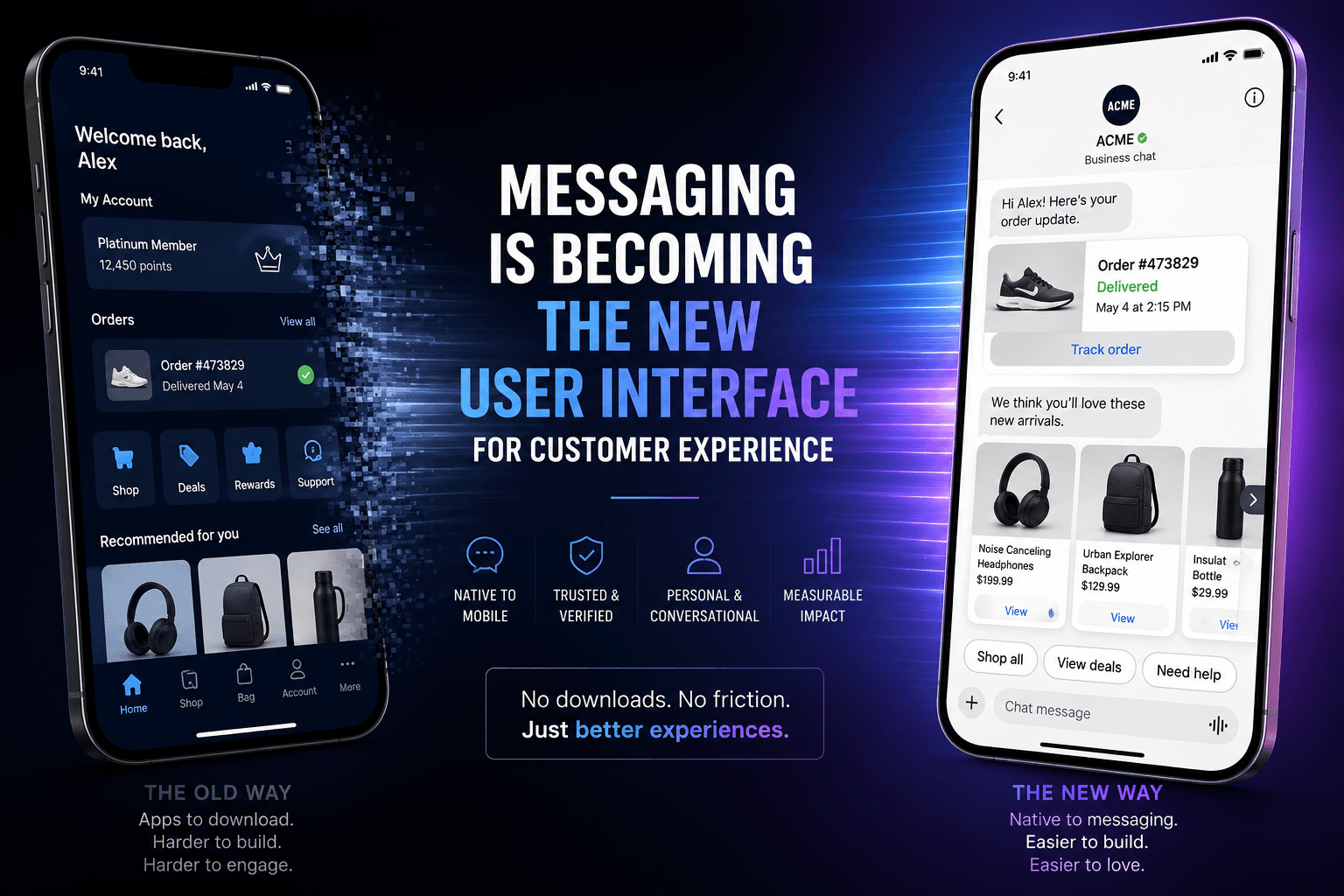
For more than two decades, brands have been forced to choose between two imperfect options:
SMS, which offers reach but limited experience.
Mobile Apps, which offer rich experiences but require massive investment and customer adoption.
Today, that tradeoff is disappearing.
Rich Communication Services (RCS) is transforming mobile messaging from a notification channel into a fully interactive customer engagement platform. And with Apple now supporting RCS alongside Android, the market has reached a tipping point.
This is no longer a future trend.
It is a present-day competitive advantage.
The enterprises that move now will establish direct, trusted customer relationships inside the most frequently used application on every smartphone: messaging.
The enterprises that wait will find themselves playing catch-up.
Mobile Has Already Won
Consumers have made their choice.
Mobile is where they search.
Mobile is where they shop.
Mobile is where they watch.
Mobile is where they communicate.
Yet many enterprise customer experiences remain fragmented across websites, mobile apps, email campaigns, call centers, and disconnected service channels.
The result is friction.
Customers are forced to navigate channels. Brands force customers to work harder than necessary.
The most successful organizations are moving toward a different model:
Bring the experience to the customer instead of forcing the customer to come to the experience.
That is exactly what RCS enables.
The Biggest Customer Experience Shift Since The Mobile App
Most executives still think about messaging as a notification channel.
Appointment reminders.
Shipping notifications.
Password resets.
Promotional campaigns.
That thinking is already outdated.
RCS transforms messaging into an interactive customer experience environment capable of delivering:
Rich imagery and video
Branded and verified business identities
Product carousels
Interactive buttons
Conversational AI
Secure authentication
Personalized offers
Integrated customer support
Native voice and video escalation
In practical terms, customers can now accomplish many of the same tasks previously reserved for mobile apps—without downloading anything.
The messaging thread becomes the experience.
Why This Matters To The C-Suite
The conversation around RCS is often delegated to marketing teams.
That is a mistake.
RCS is not simply a marketing technology.
It is a business transformation initiative.
The implications extend across:
Marketing
Higher engagement.
Higher conversion rates.
Richer first-party customer interactions.
Customer Service
Reduced call center volume.
Faster issue resolution.
Improved customer satisfaction.
Sales
Frictionless buying journeys.
Personalized product discovery.
Real-time conversational engagement.
Digital Transformation
Lower dependency on expensive mobile application development.
Faster deployment of customer experiences.
Unified engagement across the customer lifecycle.
Executive Leadership
Stronger customer loyalty.
Increased retention.
Greater lifetime value.
Reduced operational costs.
This is not a channel decision.
It is a customer strategy decision.
The App Economy Is Being Challenged
For years, enterprises have assumed every digital experience required a mobile app.
The reality is more complicated.
Apps are expensive.
Apps require ongoing development.
Apps require customer downloads.
Apps require constant maintenance.
Most enterprise apps struggle with engagement beyond their most loyal users.
RCS changes the equation.
Instead of asking customers to download an application they may use once per month, brands can deliver rich, interactive experiences directly inside the messaging environment customers already use every day.
That creates a dramatically lower-friction engagement model.
Not every app disappears.
But many app experiences become unnecessary.
The smartest brands are already evaluating where RCS can replace costly app functionality.
AI Makes RCS Even More Powerful
The rise of AI and the rise of RCS are occurring simultaneously.
That is not coincidence.
Messaging is becoming the primary interface between customers and businesses.
AI is becoming the intelligence layer that powers those interactions.
Together they create an entirely new engagement model.
Imagine:
Customers receiving personalized recommendations inside messaging
AI agents resolving service requests instantly
Intelligent product discovery through conversation
Real-time escalation to human agents when necessary
Seamless transitions from text to voice or video
This is not science fiction.
The technology exists today.
The question is whether organizations are prepared to deploy it strategically.
The Risk Of Waiting
Every major customer engagement transformation follows a predictable pattern.
A small number of innovators move first.
The market observes.
Adoption accelerates.
The advantage narrows.
Eventually participation becomes mandatory.
We saw it with websites.
We saw it with mobile apps.
We saw it with social media.
We saw it with SMS.
We are seeing it again with RCS.
The organizations evaluating RCS in 2026 will shape customer expectations.
The organizations evaluating RCS in 2028 will simply be trying to keep up.
The Time To Act Is Now
Enterprise leaders should be asking three questions:
Where are our highest-friction customer journeys?
Which app experiences could be delivered more effectively through messaging?
How do we combine AI and RCS to create a differentiated customer experience?
The answers will vary by industry.
The opportunity does not.
The future of customer engagement is conversational.
The future of customer engagement is mobile.
And increasingly, the future of customer engagement will be built on RCS.
The question is no longer whether RCS matters.
The question is whether your organization intends to lead the transformation—or react to it.